




Goodyear Welt vs. Cemented Cowboy Boots: Which Construction Is Better?
Goodyear welted cowboy boots are generally easier to resole and can offer better long-term repairability, while cemented cowboy boots use adhesives to attach the sole and can provide a lighter, more flexible construction. Neither method automatically guarantees better comfort or durability. The right choice depends on how often you wear your boots, where you wear them, and whether you expect to replace the soles in the future.
When shopping for cowboy boots, most people compare leather quality, toe shape, heel height, and brand. But there's another detail worth understanding before investing in a new pair: how the boot is constructed.
Whether you're considering everyday western boots, rugged work footwear, or premium exotic leather styles, understanding Goodyear welt vs. cemented construction can help you make a more informed purchase.
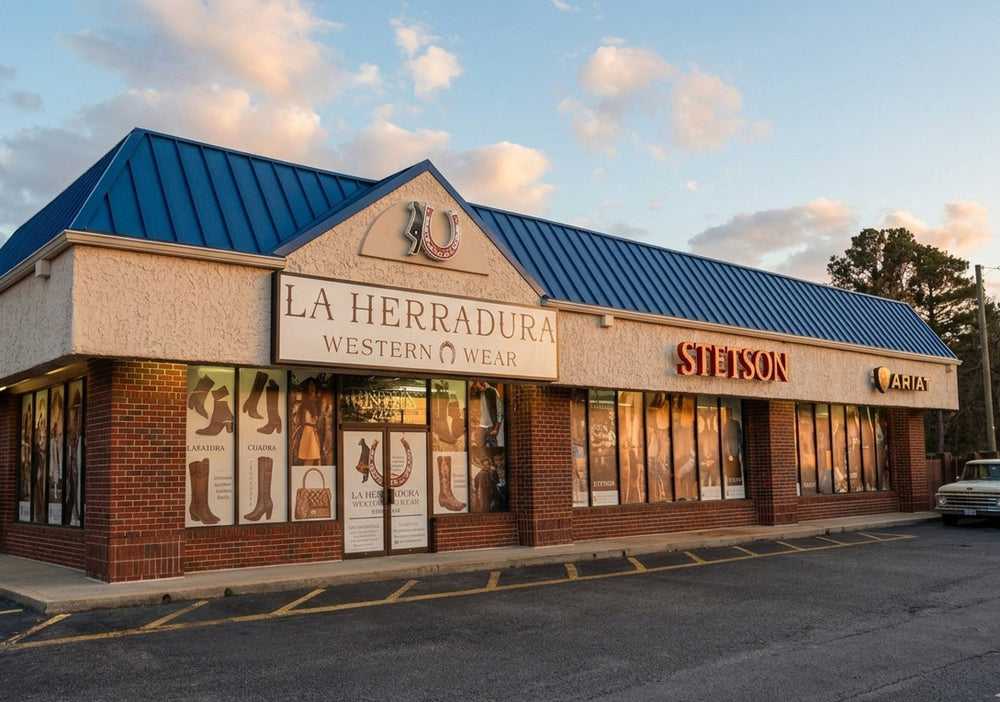
Explore men's cowboy boots at La Herradura Western Wear while learning what separates these two construction methods.
What Is Goodyear Welt Construction in Cowboy Boots?
Goodyear welt construction is a footwear manufacturing method that connects the upper portion of a boot to its sole using a separate strip of material called a welt.
In a typical Goodyear welted boot, the upper and welt are secured around the bottom of the boot, and the outsole is stitched to the welt. This creates a construction that can often be repaired without replacing the entire boot.
How Goodyear Welted Boots Are Made
The process generally involves four main components:
-
Upper: The leather or other material forming the foot and shaft of the boot.
-
Insole: The internal foundation beneath the foot.
-
Welt: A narrow strip connecting the upper assembly to the outsole.
-
Outsole: The external surface that contacts the ground.
The outsole is stitched to the welt rather than relying exclusively on adhesive.
This construction method is associated with traditional shoemaking and is used in many premium leather footwear designs.
Advantages of Goodyear Welted Cowboy Boots
-
Resoleability: Many Goodyear welted boots can have their worn outsoles replaced by a qualified cobbler.
-
Long-term serviceability: Repairing the sole may extend the usable life of a well-maintained boot.
-
Structural stability: The construction can provide a substantial foundation underfoot.
-
Traditional craftsmanship: Welted construction is an established method in quality footwear manufacturing.
-
Potential long-term value: Repairing a good pair may be more economical than replacing it repeatedly.
However, Goodyear welt construction does not guarantee waterproofing, exceptional comfort, or unlimited repairs. Materials, design, workmanship, and maintenance all matter.
What Are Cemented Cowboy Boots?
Cemented construction attaches the outsole to the boot's upper assembly using specialized footwear adhesives rather than a stitched welt-to-outsole connection.
The word cemented refers to the bonding method, not to a rigid or concrete-like material.
This construction is common in various types of casual footwear, fashion boots, and performance-oriented designs.
How Cemented Boots Are Made
The manufacturer prepares the surfaces of the upper assembly and outsole, applies an appropriate bonding system, and joins the components under controlled conditions.
The quality of the bond depends on factors such as surface preparation, adhesive selection, materials, pressure, and manufacturing standards.
Advantages of Cemented Cowboy Boots
-
Design flexibility: Manufacturers can use different sole materials and shapes.
-
Potentially lighter construction: Some cemented designs eliminate components required in traditional welted footwear.
-
Flexible feel: Certain models can feel more flexible from the beginning.
-
Production efficiency: The process can require fewer manufacturing steps.
-
Different price options: Cemented construction may help manufacturers offer boots at more accessible prices.
A well-made cemented boot can still provide dependable everyday performance.
Its main limitation is that replacing the entire outsole may be more difficult, less economical, or impractical depending on the materials and construction.
Goodyear Welt vs. Cemented Boots: Side-by-Side Comparison
| Feature | Goodyear Welt Construction | Cemented Construction |
|---|---|---|
| Sole attachment | Welt and stitching | Specialized adhesive |
| Resoleability | Usually more repair-friendly | Depends on design and materials |
| Initial flexibility | Can feel relatively structured | Can be flexible from the start |
| Weight | Often more substantial | Can be lighter |
| Water resistance | Depends on materials and sealing | Depends on materials and bonding |
| Production complexity | Generally higher | Generally lower |
| Repair costs | Resoleing may be practical | Full sole replacement may be difficult |
| Long-term value | Strong potential with proper care | Depends on price, quality, and use |
| Best suited for | Buyers prioritizing repairability | Buyers prioritizing particular design or performance features |
The biggest difference is repairability. Goodyear welt construction is generally designed to accommodate outsole replacement, whereas cemented construction is less consistently repairable.
Neither method alone determines the quality of the finished boot.
Are Goodyear Welted Cowboy Boots More Durable?
Goodyear welted boots can provide excellent long-term durability, especially when the upper leather, stitching, insole, and other components are made to a high standard.
However, construction alone does not determine how long a boot lasts.
Consider two different pairs:
-
A Goodyear welted boot made with poor-quality leather and inadequate finishing.
-
A cemented boot made with durable materials, a well-designed outsole, and carefully controlled adhesive bonding.
The second boot could perform better under certain conditions.
What Actually Determines Cowboy Boot Durability?
Leather quality: Strong, properly finished leather can better withstand normal wear.
Outsole material: Rubber, leather, and synthetic compounds have different wear characteristics.
Construction quality: Stitching, bonding, reinforcement, and assembly accuracy influence performance.
Fit: Poorly fitting boots may experience abnormal wear and cause discomfort.
Usage: Daily ranch work places different demands on footwear than occasional social events.
Maintenance: Cleaning, conditioning, drying, and storage influence the life of leather footwear.
For premium western styles, explore Cuadra men's boots, including traditional leather and exotic leather designs.
Always confirm the construction method of the specific model before assuming it uses a Goodyear welt.
Can Goodyear Welted Cowboy Boots Be Resoled?
Yes. Many Goodyear welted cowboy boots are designed so that a qualified repair professional can remove the worn outsole and attach a replacement.
This is one of the construction method's most valuable characteristics.
When Should You Resole Cowboy Boots?
Consider professional inspection when you notice:
-
Significant outsole thinning.
-
Holes or exposed internal layers.
-
Excessive wear near the ball of the foot.
-
Damaged sole stitching.
-
Uneven wear that affects stability.
-
Separation between sole components.
Do not wait until damage spreads into the welt, insole, or upper.
How Many Times Can Goodyear Welted Boots Be Resoled?
There is no universal number.
The answer depends on the condition of the welt, upper, insole, stitching, and overall construction.
A well-maintained pair may support multiple repairs, while a damaged or poorly constructed pair may not be suitable for another resole.
A professional cobbler should inspect the boots before recommending repair.
Can Cemented Cowboy Boots Be Resoled?
Sometimes, but it depends on the specific boot.
Certain cemented outsoles can be removed and replaced by specialized repair shops. Other designs are difficult to repair because the outsole, midsole, and upper materials are permanently bonded or may be damaged during separation.
For some cemented boots, replacing the outsole may cost more than the economic value of the footwear.
What Repairs Are Still Possible?
Depending on the model, a repair shop may be able to:
-
Replace worn heel components.
-
Repair limited areas of sole separation.
-
Restore certain leather surfaces.
-
Replace insoles or footbeds.
-
Perform minor stitching repairs.
These services should not be confused with a complete outsole replacement.
Buying tip: If you want to keep the same pair of cowboy boots for many years, ask about sole repairability before purchasing.
Are Goodyear Welted Boots More Comfortable Than Cemented Boots?
Not necessarily.
Comfort depends primarily on how the boot fits your foot and how its components support movement.
Important factors include:
-
Toe-box space.
-
Width and instep fit.
-
Arch support.
-
Footbed cushioning.
-
Heel height.
-
Outsole flexibility.
-
Boot weight.
-
Intended activity.
A cemented boot with a supportive footbed may feel more comfortable to one wearer than a traditionally welted boot.
Likewise, a well-fitted welted boot can offer excellent everyday comfort.
Do Goodyear Welted Boots Need a Break-In Period?
Some do.
Traditional leather components can feel relatively firm when new. As the boot is worn, certain materials may soften and adapt to the wearer's movement.
However, the break-in experience varies by model.
You should never rely on breaking in boots to correct severe pressure, incorrect sizing, or painful fit.
For a broader selection of everyday and performance-oriented footwear, explore Ariat boots.
Which Construction Is Better for Ranch Work?
For ranch work, the most important consideration is whether the entire boot is suitable for the tasks and conditions.
A repairable welted boot may appeal to someone who wears boots frequently and wants to maintain them over several years.
However, cemented or other specialized constructions may also be appropriate when they offer the required traction, flexibility, comfort, or protective features.
What to Look for in Ranch Boots
Outsole traction: Choose a tread suitable for the terrain.
Moisture protection: Consider water-resistant or waterproof designs when necessary.
Foot support: Long workdays require a stable, comfortable fit.
Durability: Evaluate the outsole, upper, stitching, and reinforcements.
Safety requirements: For hazardous work, choose footwear that meets the applicable protective standards.
Repairability: Consider whether replacement soles and qualified repair services are available.
For western and work footwear, compare the available styles in the Ariat boot collection.
Do not assume that every western boot is designed or certified for demanding occupational use.
Which Construction Is Better for Everyday Cowboy Boots?
For everyday wear, both methods can be appropriate.
If you wear cowboy boots frequently, value traditional construction, and want the possibility of future resoling, Goodyear welted boots may be worth considering.
If you prioritize a particular lightweight design, flexible outsole, or price point, a cemented boot may meet your needs.
Choose Goodyear Welt Construction If You:
-
Want boots with strong potential for future sole replacement.
-
Prefer traditional stitched construction.
-
Plan to maintain your boots over several years.
-
Are comfortable paying more for certain repairable designs.
-
Value long-term serviceability.
Consider Cemented Construction If You:
-
Prefer a specific lightweight or flexible design.
-
Wear the boots occasionally.
-
Have a defined budget.
-
Do not expect to resole the footwear.
-
Find a model with the fit and performance features you need.
The best choice is the pair that fits correctly and suits your intended use.
Goodyear Welt vs. Cemented Construction in Exotic Leather Boots
Premium exotic leather cowboy boots often attract buyers looking for distinctive textures, craftsmanship, and long-term ownership.
Common materials include ostrich, caiman, python, and pirarucu.
Because these boots can represent a significant investment, construction and repairability deserve particular attention.
Why Construction Matters for Exotic Boots
The upper leather may remain in good condition even after the outsole has worn down.
If the boot has a repairable construction, replacing the sole may help preserve the original upper.
However, exotic leather requires material-specific care, and not every exotic boot uses the same construction method.
Questions to Ask Before Buying
-
Is the outsole stitched, cemented, or attached using another construction method?
-
Does the manufacturer identify the boot as Goodyear welted?
-
Can a qualified cobbler replace the outsole?
-
Are replacement parts available?
-
What care does the exotic leather require?
-
Is the boot intended for dress wear or regular use?
Explore Cuadra men's boots and the wider men's cowboy boot collection to compare different western leather styles.
Is Goodyear Welt Construction Waterproof?
No. Goodyear welt construction does not automatically make a cowboy boot waterproof.
Water resistance depends on the materials, seam treatments, outsole attachment, membranes, and overall design.
Stitching and construction joints may allow moisture to enter if they are not properly sealed.
Likewise, a cemented boot is not automatically waterproof simply because adhesive is used.
What About Storm Welt Construction?
A storm welt incorporates a raised or extended profile intended to help reduce water entry around the upper-to-sole junction.
It may improve protection in certain designs, but it does not guarantee waterproof performance.
If you regularly work in wet conditions, look for boots specifically designed and described as waterproof rather than relying solely on the construction method.
How to Identify Goodyear Welted Cowboy Boots
A visible line of stitching around the edge of the sole can be a useful clue, but it is not definitive proof.
Some footwear uses decorative stitching or other construction methods that resemble a Goodyear welt.
Check These Details
Manufacturer specifications: Look for an explicit statement such as "Goodyear welt construction."
Sole attachment: Review whether the manufacturer describes stitched welt construction or cemented attachment.
Repair information: Check whether the manufacturer offers resoling or recommends a specific repair process.
Product documentation: Examine the official model specifications rather than relying only on photographs.
Retailer assistance: Ask for clarification when the construction method is not stated.
A visible welt is not enough to confirm how the boot was assembled.
Goodyear Welt vs. Blake Stitch vs. Cemented Boots
Goodyear welt and cemented construction are not the only methods used in footwear.
Blake stitching is another construction technique, particularly associated with certain dress shoes and boots.
Goodyear Welt
The outsole is attached through a separate welt, providing a construction that is commonly repairable.
Blake Stitch
A stitch passes through the outsole and internal components to secure the sole assembly. Blake-stitched footwear can often be resoled using appropriate specialized equipment.
Cemented Construction
The outsole is primarily bonded with adhesive. Repairability varies depending on the materials and design.
What About Traditional Cowboy Boot Construction?
Some cowboy boots use hand-welted, pegged, stitched, or other traditional construction techniques.
A boot does not need to be Goodyear welted to be well-made or repairable.
For this reason, always identify the actual construction method rather than dividing every cowboy boot into only two categories.
Is Goodyear Welt Construction Worth the Extra Money?
It can be, particularly if you plan to wear the boots frequently and maintain them for years.
Consider the total cost of ownership rather than only the initial price.
For example, a repairable boot may justify a higher purchase price if its upper remains in good condition and future sole replacements are practical.
But resoling has a cost, and not every expensive boot is economical to repair.
Evaluate These Five Factors
-
Purchase price: What is your initial budget?
-
Frequency of use: Will you wear the boots daily or occasionally?
-
Expected lifespan: Are the materials suitable for your intended use?
-
Repair costs: Is professional resoling available at a reasonable price?
-
Personal preference: Do you value traditional construction or specific comfort features more?
A premium price alone does not prove superior construction.
Common Mistakes When Comparing Cowboy Boot Construction
Assuming all expensive cowboy boots are Goodyear welted. Price and construction method are not interchangeable.
Believing cemented boots are always low quality. Adhesive construction can be appropriate for well-designed footwear.
Confusing stitched decoration with structural stitching. Visible stitching does not necessarily identify the sole attachment method.
Assuming all Goodyear welted boots are waterproof. Waterproofing requires additional design considerations.
Ignoring fit in favor of construction. Even an exceptionally made boot will disappoint if it does not fit correctly.
Waiting too long to repair worn soles. Delayed maintenance may damage components that are more difficult to replace.
Assuming every cowboy boot uses one of these two methods. Traditional western footwear includes several additional construction techniques.
Frequently Asked Questions About Cowboy Boot Construction
Are Goodyear welted cowboy boots better than cemented boots?
Goodyear welted boots generally offer better resoling potential, while cemented boots can provide flexible, lightweight designs. Neither construction is automatically better in every situation.
Do all cowboy boots have Goodyear welt construction?
No. Cowboy boots may use Goodyear welting, other stitched constructions, pegged methods, cemented attachment, or combinations of techniques.
Can a cobbler resole Goodyear welted boots?
Usually, yes, provided the welt, upper, and other structural components remain in suitable condition.
Are cemented boots less durable?
Not necessarily. Their durability depends on adhesive quality, materials, workmanship, usage, and maintenance. They may, however, be more difficult to resole.
How can I tell whether my cowboy boots are Goodyear welted?
Check the manufacturer's specifications or contact the brand. Exterior stitching alone is not reliable proof.
Do Goodyear welted boots last longer?
They can remain serviceable longer because the outsole can often be replaced. Actual lifespan depends on construction quality, materials, wear, and care.
Are Goodyear welted boots heavier?
They can be heavier because of their construction components, but weight varies significantly by model and material.
Are cemented cowboy boots comfortable?
Yes. Cemented construction can be used in comfortable footwear. Fit, cushioning, support, and outsole design are more important than attachment method alone.
Are Goodyear welted boots good for work?
They can be, but work suitability depends on traction, protective features, fit, and the demands of the job.
Can exotic leather cowboy boots be resoled?
Some can. The answer depends on the boot's construction and condition, not simply whether the upper is made from exotic leather.
Find Cowboy Boots That Match Your Needs
Understanding Goodyear welt vs. cemented construction helps you look beyond appearance and evaluate what you're actually buying.
If repairability and traditional craftsmanship are important, investigate welted or other resoleable constructions. If flexibility, weight, and specific performance features matter more, consider the complete design rather than focusing on a single manufacturing method.
Most importantly, choose boots that fit correctly, suit your lifestyle, and provide the features you genuinely need.
At La Herradura Western Wear, you can explore:
-
Men's Cowboy Boots — Compare traditional western, everyday, and exotic leather styles.
-
Ariat Boots — Explore western and work-oriented designs.
-
Cuadra Men's Boots — Discover premium leather and exotic western footwear.
-
Women's Cowboy Boots — Browse western boot styles for women.
Choose your next pair with confidence by comparing fit, materials, construction, and intended use—not just the brand or price.
