





What Socks to Wear With Cowboy Boots: Height & Material Guide
The right cowboy boot sock does more than keep your feet warm. It creates a layer between your skin and the boot, helps manage moisture and can reduce rubbing around your feet, ankles and lower legs.
For most traditional cowboy boots, choose a snug mid-calf or over-the-calf sock that reaches at least as high as the area where the boot shaft contacts your leg. Look for breathable, moisture-managing materials and avoid socks that are so thick that they make an otherwise correctly fitted boot feel tight.
The best sock therefore depends on your boot, the weather and what you are doing.
Someone spending a summer evening at a country concert may need a very different sock from someone working outdoors all day in Western work boots.
Browse durable options in our Men's Work Boots collection.
What Type of Socks Are Best for Cowboy Boots?
A practical cowboy boot sock should generally provide four things:
- Enough height to protect your leg from the shaft
- A secure fit that does not bunch or slide
- Appropriate moisture management
- Enough cushioning for your use without making the boot excessively tight
For traditional mid-calf cowboy boots, mid-calf and over-the-calf socks are usually the safest starting point.
Very short ankle or no-show socks leave more skin exposed to the inside of the boot.
That can become uncomfortable when the boot shaft repeatedly rubs the ankle or lower leg.
How Tall Should Cowboy Boot Socks Be?
Ideally, the sock should reach at least as high as the part of the boot shaft that contacts your leg.
For many conventional cowboy boots, this means:
Mid-calf socks
Good for many everyday Western boots.
Over-the-calf socks
Useful with traditional and taller shafts because they provide more complete coverage and are less likely to disappear below the top of the boot.
Crew socks
May work with shorter Western boots depending on shaft height.
Ankle socks
Usually provide too little protection for traditional cowboy boot shafts.
No-show socks
Generally make little sense with full-height cowboy boots because much of the lower leg remains against the boot.
The correct choice becomes easier once you understand your boot's actual shaft. See our Cowboy Boot Shaft Height Guide for the difference between short, 8-inch, 10-inch, 12-inch and tall Western boots.
Are Over-the-Calf Socks Best for Cowboy Boots?
They are one of the most versatile choices.
An over-the-calf sock extends above most of the contact area inside a traditional Western boot.
That helps prevent bare skin from rubbing against the shaft.
A properly designed tall sock can also remain in position better than a short sock that repeatedly slides beneath the boot.
This is particularly useful if you:
- Ride
- Work on your feet
- Wear boots all day
- Have a tall boot shaft
- Experience rubbing around the calf
- Frequently find shorter socks sliding down
The important word is properly fitted.
A tall sock that is excessively tight around your calf can create its own discomfort.
Can You Wear Crew Socks With Cowboy Boots?
Sometimes.
Crew socks can work reasonably well with lower-shaft boots or men's Western botines.
You can browse current short-boot styles in our Men's Botines and Ankle Boots collection.
They can also work with some conventional boots if they remain above the areas where rubbing occurs.
The problem appears when the sock ends significantly below the boot shaft.
The exposed skin may then rub against:
- Leather lining
- Stitching
- Shaft edges
- Decorative seams
- Unlined leather
If your crew socks continually disappear into the boot, move to a taller sock.
Can You Wear Ankle Socks With Cowboy Boots?
You technically can, but ankle socks are generally not ideal for full-height cowboy boots.
They protect the foot while leaving much of the ankle and lower leg uncovered.
That may lead to irritation where the shaft contacts the skin.
An ankle sock makes considerably more sense with a Western ankle boot than with a traditional 11 or 12-inch cowboy boot.
For short-boot options, compare Botines vs Full Cowboy Boots.
Should Cowboy Boot Socks Be Thick or Thin?
Neither is automatically better.
Sock thickness should complement the fit of your boot.
Choose thinner socks when:
- Your boots already fit snugly
- The weather is warm
- You want less bulk
- You prefer more direct foot-to-boot feel
- Thick socks create pressure at the instep or toe box
Choose moderately cushioned socks when:
- You stand or walk for long periods
- You want additional padding
- Your boots have sufficient internal room
- You are working or riding for extended periods
Choose warmer, heavier socks when:
- Temperatures are low
- Your boots still fit correctly with them
- Additional insulation is useful
Do not try to correct a significantly oversized boot simply by wearing extremely thick socks.
And do not force a thick winter sock into a properly fitted boot if it creates pressure.
Can Thick Socks Make Cowboy Boots Too Tight?
Absolutely.
A sock occupies space inside the boot.
Increasing sock thickness can affect:
- Toe room
- Instep pressure
- Ball-of-foot fit
- Heel movement
- Overall circulation and comfort
If a cowboy boot fits perfectly with a medium-weight sock but becomes painfully tight with a heavy wool sock, the problem is not necessarily the boot.
You changed the effective internal fit.
This is why the socks you expect to wear regularly should be considered when trying on cowboy boots.
Use our Cowboy Boot Fit Guide to understand how the foot itself should sit inside the boot.
Can Socks Fix Cowboy Boots That Are Too Big?
They can make a slightly roomy boot feel more secure, but socks should not be used to disguise fundamentally incorrect sizing.
A thicker sock may reduce small amounts of extra volume.
It cannot reliably correct:
- Excessive boot length
- Incorrect width
- Poor instep fit
- Wrong heel placement
- Incorrect foot shape
- Major sizing errors
Before trying to solve fit problems with socks, review the Cowboy Boot Sizing & Width Guide.
If the boot is genuinely the wrong size, correcting the size is usually better than building layers around your foot.
What Material Is Best for Cowboy Boot Socks?
There is no single best fiber for every person and season.
Common choices include:
- Merino wool
- Wool blends
- Synthetic performance fibers
- Polyester blends
- Nylon blends
- Cotton blends
- Elastane or spandex blended for stretch and retention
Each has advantages and tradeoffs.
The more useful question is:
How well does the complete sock manage moisture, temperature, friction and fit inside your particular boot?
Is Merino Wool Good for Cowboy Boots?
Yes.
Merino wool can be an excellent cowboy boot sock material because it provides useful temperature regulation and moisture management while remaining available in relatively lightweight constructions.
It is particularly useful for:
- Cooler weather
- Long days in boots
- Outdoor use
- People who want insulation without relying only on extremely thick socks
Merino socks also come in different weights.
A lightweight merino sock can work very differently from a heavy winter hiking sock.
Do not assume the word "wool" automatically means thick.
Are Wool Socks Only for Winter Cowboy Boots?
No.
Heavy wool socks are obviously useful in cold weather, but lighter merino blends can also be used across a broader range of temperatures.
The appropriate choice depends on:
- Fiber weight
- Knit density
- Boot ventilation
- Activity level
- Outdoor temperature
- Personal heat tolerance
For cold-weather Western clothing beyond socks, see How to Layer Western Wear for Cold Weather.
Are Cotton Socks Good With Cowboy Boots?
Cotton socks can feel comfortable for casual use, particularly when the wearer is not sweating heavily.
However, cotton tends to hold moisture rather than move it away as effectively as many performance-oriented wool and synthetic blends.
That can become noticeable during:
- Hot weather
- Ranch work
- Long walks
- Riding
- Dancing
- Extended wear
A cotton blend may still work perfectly well for short casual use.
For longer or more demanding days, moisture management becomes more important.
Are Polyester Socks Good for Cowboy Boots?
Performance polyester blends can work very well.
They are commonly designed to:
- Move moisture
- Dry relatively quickly
- Maintain shape
- Reduce bunching
- Provide targeted cushioning
The exact performance depends on the sock construction rather than the word "polyester" alone.
A well-designed performance sock and a cheap generic polyester sock are not necessarily comparable products.
Look at the complete design.
What Does Moisture-Wicking Mean in Boot Socks?
Moisture-wicking materials are designed to move perspiration away from the skin toward areas where it can evaporate more effectively.
This matters because cowboy boots cover much of the foot and lower leg.
Sweat trapped inside a boot can contribute to:
- Dampness
- Odor
- Friction
- Sock movement
- General discomfort
If your feet become sweaty during long days, choose breathable socks designed specifically for moisture management.
What Socks Are Best for Cowboy Boots in Summer?
For warm weather, prioritize:
- Breathability
- Moisture management
- Light or moderate thickness
- Secure fit
- Adequate shaft coverage
You generally want protection from the boot without excessive insulation.
A lightweight merino or performance synthetic blend can work well.
Avoid selecting an ultra-short sock simply because the weather is hot.
You can still choose a tall sock made from a light, breathable fabric.
Height and warmth are separate characteristics.
A sock can be over-the-calf without being heavy.
What Socks Are Best for Cowboy Boots in Winter?
For colder conditions, a thicker merino wool or wool-blend boot sock can provide additional warmth.
But check the fit.
Adding a significantly thicker sock to a snug cowboy boot can compress the foot and create more discomfort rather than more warmth.
Your winter sock should provide insulation while allowing the boot to fit properly.
If you regularly work in extreme winter conditions, the boot itself may also need appropriate insulation and weather protection.
A normal Western boot combined with a thick sock does not automatically become a winter work boot.
What Socks Should You Wear With Cowboy Boots for Work?
Work socks should emphasize:
- Moisture management
- Durability
- Secure fit
- Shaft coverage
- Cushioning appropriate to your job
- Compatibility with the boot
If you spend eight or ten hours walking or standing, a thin fashion sock may not provide the comfort you need.
Likewise, an extremely padded sock may create unwanted tightness.
Choose the sock as part of your footwear system.
La Herradura carries dedicated Men's Work Boots alongside traditional Men's Cowboy Boots.
If you are unsure which type of footwear suits your use, read Work Boots vs Western Boots.
What Socks Should You Wear With Cowboy Boots for Riding?
A riding sock should remain securely in position and protect the areas where the boot contacts your foot and leg.
Useful characteristics include:
- Mid-calf or taller height
- Minimal bunching
- Moisture management
- Comfortable seams
- Thickness that does not interfere with fit
- Sufficient leg coverage
Some riders prefer thinner socks because they want less bulk inside fitted riding boots.
Others prefer more cushioning during long days.
There is no universal thickness.
Riding suitability also depends much more on the complete boot than on the sock.
Well-built riding-friendly options include our Ariat Boots collection.
Compare heel geometry using our Cowboy Boot Heel Types Guide.
What Socks Are Best for Walking in Cowboy Boots?
For walking-heavy days, look for a sock that stays in place and reduces unnecessary friction.
Important characteristics include:
- Correct sizing
- Secure heel placement
- Breathability
- Moisture management
- Moderate cushioning if preferred
- Smooth seams
- No bunching beneath the foot
The sock should complement a correctly fitted boot.
It cannot compensate for an outsole or heel design that is poorly suited to your activity.
If walking is a major part of how you use your boots, also compare Leather Sole vs Rubber Sole Cowboy Boots.
Everyday walking-friendly comfort brands include our Dan Post Boots collection.
What Socks Should You Wear for Dancing in Cowboy Boots?
Dancing adds repeated movement, heat and friction.
A good sock should therefore:
- Stay up
- Stay smooth beneath the foot
- Manage moisture
- Avoid excessive thickness
- Protect the heel and ankle
- Fit securely without constriction
A sock that slides down into the shaft during dancing can become distracting very quickly.
For the rest of the outfit, see Best Jeans for Dancing in Cowboy Boots.
Do Cowboy Boot Socks Prevent Blisters?
The right sock can reduce some common causes of friction, but it cannot guarantee that blisters will never occur.
Blisters may result from several factors:
- Poor boot fit
- Excessive movement
- Damp skin
- Sock bunching
- Rough seams
- New footwear
- Long periods of walking
- Incorrect sizing
A moisture-managing, properly fitted sock creates a better interface between your skin and the boot.
But persistent blistering can also indicate that the boot itself does not fit correctly.
Should Cowboy Boot Socks Have Cushioning?
Cushioning is a preference and use-case decision.
Some boot socks include additional padding at:
- Heel
- Ball of foot
- Toe
- Sole
That can be useful for long periods of standing or walking.
However, additional cushioning also takes up internal volume.
If your boot is already close-fitting, heavy cushioning may make it too tight.
A well-designed thin sock can sometimes be more comfortable than a heavily padded one when space is limited.
Should Cowboy Boot Socks Be Tight?
They should be secure, not restrictive.
A good boot sock should:
- Stay in place
- Avoid wrinkles
- Avoid bunching
- Hold comfortably around the foot
- Remain up on the leg
It should not:
- Cut deeply into the calf
- Numb the foot
- Restrict circulation
- Compress the toes
- Create painful pressure
If you remove your boot and find severe sock compression marks combined with discomfort, reconsider the sock size or design.
Why Do My Socks Slide Down Inside Cowboy Boots?
Common causes include:
- Sock is too short
- Elastic has weakened
- Sock is too large
- Fabric stretches excessively
- Shaft friction pulls the sock downward
- Sock is not designed for tall boots
Moving to a properly sized mid-calf or over-the-calf sock often helps.
Tall socks should still have enough elasticity to stay up without painfully constricting the leg.
Why Do My Socks Bunch Under My Feet in Cowboy Boots?
Bunching can happen when the sock:
- Is too large
- Has poor shape retention
- Slides down
- Contains excess fabric
- Does not match your foot shape
Once fabric folds underneath the foot, it can create pressure and friction.
Choose socks according to your actual foot size rather than buying an unnecessarily oversized pair.
Should You Wear Two Pairs of Socks With Cowboy Boots?
Usually, one properly chosen pair is simpler and more predictable.
Layering socks changes the volume inside the boot and can make the fit much tighter.
Two layers can sometimes be useful in specific cold-weather or friction-management situations, but they should not be used automatically.
If two pairs are required merely to stop your foot from moving inside the boot, reassess the boot size and width.
Should You Wear Socks When Breaking In Cowboy Boots?
Yes.
Wear the type of sock you realistically expect to use with the boots.
Breaking boots in with an unusually thin sock and then switching permanently to a much thicker one changes the fit conditions.
Likewise, do not intentionally wear several extremely thick socks in an attempt to aggressively stretch a new boot.
Leather can adapt somewhat with wear, but the goal is comfortable break-in, not forcing incorrectly sized footwear.
Use the Cowboy Boot Fit Guide before deciding that a new boot simply "needs breaking in."
Can Socks Change Heel Slip in Cowboy Boots?
They can influence it slightly.
A thicker sock may fill more internal volume and reduce some movement.
But heel slip is primarily a boot-fit issue rather than a sock problem.
Some initial heel movement can occur in properly fitted Western boots depending on their construction.
If your heel is moving excessively, do not keep increasing sock thickness indefinitely.
Check:
- Boot length
- Width
- Instep fit
- Ball placement
- Overall size
For brand-specific differences, read How Cowboy Boot Sizing Differs by Brand.
Do Socks Matter More With Exotic Cowboy Boots?
The principles are largely the same.
Your sock interacts mostly with the inside of the boot, while exotic leather such as caiman, python, ostrich or pirarucu is often used externally.
But expensive Exotic Cowboy Boots make proper overall fit even more important because you want the boots to be comfortable enough to wear rather than sitting unused.
You can view current exotic styles in our Ranchera Exotic Collection.
Do not purchase the wrong size expecting a particular sock to solve it.
For exotic material differences, read Pirarucu vs Caiman vs Ostrich vs Python Boots.
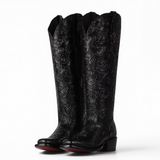
What Socks Should Women Wear With Tall Cowboy Boots?
Tall women's Western boots make sock height especially important.
The sock should protect the areas where the tall shaft contacts the leg.
Depending on the boot, an over-the-calf or knee-high sock may be more practical than a crew sock.
The sock should remain smooth underneath the boot and should not create a thick ridge around the calf.
This matters with tall styles from the Women's Cowboy Boots collection.
If you are unsure where the shaft should sit, see Cowboy Boot Shaft Height Explained.
What Socks Should Men Wear With Cowboy Boots?
For most traditional men's cowboy boots, start with a mid-calf or over-the-calf boot sock.
Then adjust material and thickness according to use.
Everyday wear:
Light or medium-weight breathable boot sock.
Summer:
Lightweight moisture-managing sock.
Winter:
Merino wool or warmer blend if the boot has enough room.
Work:
Durable performance sock with suitable cushioning and moisture management.
Riding:
Secure taller sock that does not bunch inside the boot.
These principles work across Men's Cowboy Boots, Ariat Boots, Cuadra Men's Boots, Justin Men's Boots and Dan Post Boots.
Cowboy Boot Socks by Use
| Use | Useful Sock Characteristics |
|---|---|
| Everyday wear | Mid-calf or taller, breathable, light to medium weight |
| Hot weather | Lightweight, moisture-managing, breathable |
| Cold weather | Merino or warmer blend, appropriate thickness |
| Ranch/work | Durable, moisture-managing, secure, cushioned as needed |
| Riding | Taller, secure fit, minimal bunching |
| Dancing | Breathable, secure, low-bulk |
| Tall women's boots | Over-the-calf or knee-high coverage |
| Botines | Crew or taller depending on shaft |
The table is a starting point rather than a rigid rule.
The final choice should always work with the actual boot and your foot.
Cowboy Boot Socks FAQs
Do you need special socks for cowboy boots?
Not necessarily, but socks designed for boots often provide useful height, moisture management and fit. The important thing is that the sock protects your leg, stays in position and works with the boot's internal fit.
Should cowboy boot socks go above the boot?
They do not always need to extend visibly above the boot, but they should provide enough coverage to prevent the shaft from repeatedly rubbing bare skin.
Are knee-high socks good for cowboy boots?
Yes, particularly with tall shafts. They provide excellent lower-leg coverage as long as they fit comfortably and do not constrict the calf.
Are crew socks okay with cowboy boots?
They can be suitable for short boots and some lower shafts. For traditional tall cowboy boots, a higher sock is usually more reliable.
Are ankle socks bad for cowboy boots?
They are not inherently harmful, but they leave much of the ankle and leg exposed to shaft friction. Taller socks are generally more practical for full-size cowboy boots.
Can you wear regular socks with cowboy boots?
Yes, if they are tall enough, fit securely and provide the comfort you need. A sock does not have to be marketed specifically as a cowboy boot sock.
Are thick socks better for cowboy boots?
Not automatically. Thick socks provide more insulation and cushioning but also reduce space inside the boot. Choose thickness according to fit, weather and activity.
Is merino wool good for cowboy boot socks?
Yes. Merino wool can provide moisture management, temperature regulation and comfort in both lightweight and heavier constructions.
Are cotton socks okay with cowboy boots?
They can work for casual wear, but cotton tends to retain moisture more than many wool and performance synthetic blends. For long or sweaty days, moisture-managing materials may be more comfortable.
Why do my cowboy boots rub my calves?
Possible reasons include an exposed leg above a short sock, a stiff shaft, poor fit or the geometry of the boot. Wearing a taller sock can reduce direct skin contact but cannot correct every fit problem.
Why do my cowboy boots hurt with thick socks?
The thicker sock may be taking up too much interior space and increasing pressure at the toes, instep or ball of the foot.
What socks should I wear when trying on cowboy boots?
Wear a sock similar in height and thickness to what you expect to use regularly. This gives you a more realistic understanding of the final fit.
Think of Socks as Part of Cowboy Boot Fit
A cowboy boot does not interact directly with your foot in isolation.
The sock sits between the two.
Changing the sock can change how the boot feels.
That is why the right approach is:
Choose enough height to protect your leg.
Choose a material suited to your climate and activity.
Choose enough cushioning for comfort without creating pressure.
Choose a secure fit that does not slide or bunch.
Then evaluate the boot with that sock on.
For traditional Western boots, start with a quality mid-calf or over-the-calf sock rather than a no-show style.
For summer, reduce weight rather than height.
For winter, increase warmth only as much as the boot fit allows.
For work and riding, prioritize moisture management, durability and a secure fit.
Then complete the footwear decision using our Cowboy Boot Fit Guide, Cowboy Boot Sizing & Width Guide, Cowboy Boot Shaft Height Guide, Cowboy Boot Heel Types Guide and Leather Sole vs Rubber Sole Guide.
For everyday hat and boot upkeep between wears, browse our hat and boot care accessories.
And when you are ready for the boots themselves, browse Men's Cowboy Boots, Women's Cowboy Boots, Cuadra Men's Boots, Ariat Boots and Exotic Cowboy Boots.
The right cowboy boot sock should almost disappear from your attention once the boots are on. It should protect, manage moisture and stay in place without becoming the reason your boots feel uncomfortable.
