



Cowboy Boot Sizing & Width Guide: Find Your Right Fit
Cowboy Boot Sizing and Width Guide: Why Boots Fit Differently Than Sneakers
You know your sneaker size. You order cowboy boots in the same size. They arrive and suddenly the fit feels completely different.
Your heel moves. The top of your foot feels snug. The toe looks long even though your toes are not touching the end. You may immediately assume you ordered the wrong size.
Often, you did not.
Cowboy boots are built and fitted differently from sneakers. They have no laces to tighten around your foot. The instep helps hold the boot in place. New leather changes as you wear it. A small amount of heel movement can also be normal before the sole begins to flex.
Understanding these differences can save you from sizing up when you actually need more width or returning a boot that may already fit correctly.
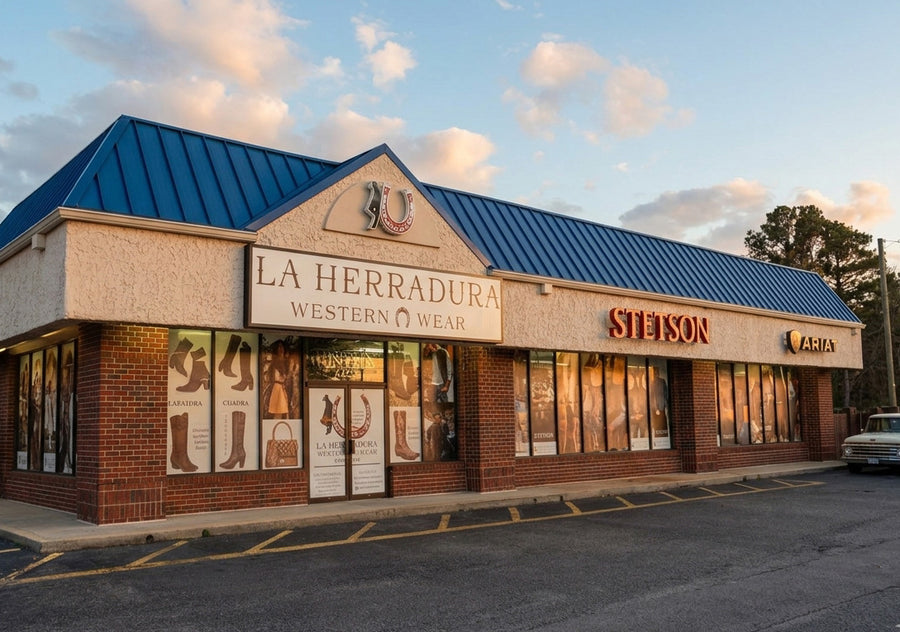
At La Herradura Western Wear, we help customers compare different boot sizes, widths, toe shapes and brands in person. This guide explains what you should actually feel when trying on cowboy boots and why your sneaker size is only a starting point.
Why Do Cowboy Boots Fit Differently Than Sneakers?
Cowboy boots fit differently because they use a pull-on construction instead of laces to secure your foot. The boot relies heavily on the instep, heel and shape of the last for support. New leather also molds across the foot with wear, so a properly fitted new boot usually feels more secure than a sneaker.
Think about what happens when you put on running shoes.
You slide your foot inside and use the laces to adjust the fit. If your foot needs more room across one area, the laces provide some flexibility.
Cowboy boots do not give you that adjustment.
The shape of the boot itself has to hold your foot correctly.
That is why shoppers should pay attention to more than the number printed inside the boot. Length matters, but so do width, instep volume, heel movement, the position of the ball of your foot and the shape of the last.
If you are shopping for a new pair, browse our men's cowboy boots while using the fit principles below to narrow your options.
Should Cowboy Boots Be the Same Size as Sneakers?
Not necessarily. Your normal sneaker size is a useful starting point, but it should not be treated as a guaranteed cowboy boot size. Some people wear boots about half a size smaller than their sneakers while others remain in the same size. Brand, width, foot shape and the boot's last all influence the final fit.
Sneakers are designed around a different type of movement and construction.
They often have cushioning around the heel and tongue along with adjustable laces. Cowboy boots depend much more heavily on their fixed shape.
That means the familiar feeling of your sneakers should not become your test for whether a cowboy boot fits.
Instead of asking, "Does this feel like my sneakers?" ask:
-
Is the ball of my foot in the correct position?
-
Is my instep secure without painful pressure?
-
Can my toes move comfortably?
-
Is the width supporting my foot without squeezing it?
-
Is the heel movement reasonable for a new boot?
Those questions tell you far more than comparing the size labels.
What Should a Properly Fitted Cowboy Boot Feel Like?
A properly fitted cowboy boot should feel snug across the instep without causing pain. The ball of your foot should align with the widest part of the sole. Your toes should move freely without touching the front and a small amount of heel slip can be normal when the boots are new.
The word "snug" causes plenty of confusion.
Snug does not mean painful.
You should feel the boot holding your foot securely but you should not experience numbness, sharp pressure or crushed toes.
There are five areas worth checking every time you try on a pair.
1. Where Should the Ball of Your Foot Sit?
The ball of your foot should sit over the widest part of the boot's sole.
This is one of the most useful fit checks because it determines where the boot naturally bends when you walk.
If the ball of your foot sits too far forward or too far behind that point, changing width alone may not solve the problem. You may need a different length or a different last.
Stand when checking this.
Your foot spreads under your body weight so evaluating fit only while sitting can give you the wrong impression.
2. How Should the Instep of a Cowboy Boot Fit?
The instep is the area across the top of your foot and it plays a major role in holding a pull-on boot in place.
A good fit should feel firm and secure.
When you pull on a properly fitted cowboy boot, you will usually feel some resistance before your heel settles into position. If your foot drops into the boot with almost no resistance and moves around easily, the boot may be too large or too wide.
Painful pressure is different.
If the top of your foot feels severely compressed, do not assume you simply need to suffer through the break-in period. You may need another width, size or boot shape.
3. Is Heel Slip Normal in New Cowboy Boots?
Yes. A small amount of heel slip is normal in many new cowboy boots. Around one-quarter inch of movement can occur because a new sole is still stiff and has not started flexing naturally with your foot. Heel movement usually decreases as the boot breaks in and conforms to your foot.
This is probably one of the most misunderstood parts of cowboy boot sizing.
Someone accustomed to sneakers feels the heel move and immediately thinks the boot is too big.
Then they size down.
Now the heel feels tighter but the ball of the foot sits incorrectly and the toes become crowded.
A small amount of early movement is not the same as a loose boot.
Your heel should not feel as though it is lifting completely out of the boot while you walk. The rest of your foot should also feel secure.
Judge heel slip together with the instep, width and ball position rather than treating it as an isolated measurement.
4. How Much Toe Room Should Cowboy Boots Have?
Your toes should have enough room to rest and move naturally without pressing into the front of the boot.
Around half an inch between your longest toe and the end can be a useful reference in many styles, but the position of the ball of your foot remains more important than trying to measure empty space visually.
Do not press hard on a structured cowboy boot toe to locate your toes.
Instead, pay attention to how your toes feel inside.
They should not be curled, compressed or constantly touching the end while you stand and walk.
5. How Should the Boot Shaft Fit?
The shaft should sit comfortably around your lower leg and calf without making the boot difficult or painful to wear.
Some shafts naturally fit closer than others.
Your calf size, the shaft height and the boot design all influence this area. If the foot fits correctly but the shaft is uncomfortably tight, look for another shaft profile instead of unnecessarily increasing your foot size.
What Do Cowboy Boot Widths B, D and EE Mean?
Boot width tells you how much room the footwear provides across the foot. Men's cowboy boots commonly use B for narrow, D for standard or medium and EE for wide. Women's sizing commonly uses different width conventions. Exact dimensions can vary by manufacturer, so the width letter should be treated as a starting reference.
For men's boots, you will commonly encounter:
-
B: Narrow
-
D: Standard or medium
-
EE: Wide
-
EEE: Extra wide on styles where it is offered
Width is not a secondary detail.
It can completely change how the same boot size feels.
Suppose your normal length is size 10. A 10D feels painfully tight across the widest part of your foot but your toes have enough length.
Going to an 11D may create unnecessary space in front of the toes and allow your heel to move too much.
A 10EE may be the better solution because it addresses the actual problem.
That distinction is one of the most important things to understand when buying cowboy boots online.
Should You Size Up If Cowboy Boots Feel Tight?
Not automatically. If the boot has enough length but feels tight across the sides or ball of your foot, you may need a wider width rather than a longer size. If your toes touch the end or the ball of your foot does not align correctly, changing the length may be appropriate.
Always identify where the pressure is coming from first.
A boot that is too short and a boot that is too narrow can both feel "too small" but they require different solutions.
Signs you may need more width:
-
Pressure along both sides of the foot
-
Squeezing around the ball of the foot
-
Foot visibly pushing beyond the intended shape of the boot
-
Correct toe room but uncomfortable side pressure
Signs you may need more length:
-
Toes touching the front
-
Ball of the foot sitting too far forward
-
Toes remaining crowded even when the width feels appropriate
Changing the wrong measurement often creates another fit problem.
Do Cowboy Boots Stretch After You Wear Them?
Genuine leather cowboy boots can soften and give slightly across the width and instep as they mold to your feet. They do not meaningfully become longer. A boot that is comfortably snug may improve with wear but a boot that is painfully short should not be purchased with the expectation that break-in will fix it.
This is where the phrase "they will stretch" needs context.
Leather can adapt.
That does not mean every sizing problem disappears.
The vamp can soften. The boot can conform more closely to the shape of your foot. The sole becomes more flexible and early heel movement can decrease.
The reinforced toe area will not suddenly provide another half size of usable length.
Different leathers also behave differently.
A softer leather may give more readily while structured exotic leathers can be considerably less forgiving. If you are considering ostrich, caiman or other specialty hides, understanding the leather itself becomes part of choosing the correct fit.
Does Toe Shape Change Cowboy Boot Sizing?
Toe shape changes the space and sensation around your toes but it should not be used to compensate for an incorrect boot width. Square and wide square toes can feel roomier while snip and pointed styles create a narrower profile. The ball of your foot and instep still need to fit correctly regardless of toe shape.
A wide square toe can feel very different from a pointed boot even when both carry the same size label.
That does not necessarily mean one is larger.
The front of the boot is simply shaped differently.
Common Western toe profiles include:
-
Wide square toe
-
Square toe
-
Narrow square toe
-
Round toe
-
Roper toe
-
Cutter toe
-
Snip toe
-
Pointed toe
If you have a wider forefoot, a square or wide square toe may feel more natural. If you prefer a refined dress profile, you may be drawn toward a snip or pointed style.
Our cowboy boot toe shapes guide explains how these profiles differ and what to consider before choosing one.
Why Can the Same Boot Size Fit Differently Between Brands?
Cowboy boot sizing varies because brands build footwear around different lasts. A last is the foot-shaped form used to create the boot. Differences in the last can change instep volume, heel shape, forefoot width and overall feel even when two boots carry exactly the same numerical size and width.
This explains a situation we see often.
Someone owns a size 10 from one brand and assumes every future cowboy boot should be a 10.
Then another brand feels completely different.
Nothing unusual has happened.
The two boots were simply built differently.
Even a D width is not guaranteed to feel identical from one manufacturer to another.
La Herradura carries Western boot brands with very different constructions and fits. If you regularly compare brands such as Cuadra, Ariat, Justin and Dan Post, read our cowboy boot sizing by brand guide before assuming your size will transfer perfectly between them.
How Do Cuadra Boots Fit Compared With Other Brands?
Cuadra deserves special attention because many shoppers buying premium or exotic Western boots encounter the brand after already owning more conventional cowboy boots.
Cuadra boots generally have a narrower feel in many styles. Someone with an average or wide foot may therefore experience more pressure than expected even when ordering their usual length.
This does not automatically mean you should increase the length.
Evaluate the width, instep and individual style first.
Exotic leather matters too. Softer ostrich and firmer caiman do not respond to wear in exactly the same way.
If you are considering the brand, browse the Cuadra men's boots collection and use our Cuadra Boots Guide to understand the materials and fit before choosing a pair.
How Can You Measure Your Feet for Cowboy Boots at Home?
Measuring your feet gives you a better starting point when ordering online.
Place a piece of paper on a hard floor with one edge against a wall. Stand naturally with your heel against the wall and mark the position of your longest toe.
Measure from the wall to that mark.
Then measure across the widest part of your foot around the ball.
Repeat the process for both feet.
Many people have one foot that is slightly larger than the other. When there is a noticeable difference, use the larger foot as the main reference.
It is also helpful to measure later in the day because feet can become slightly larger after hours of standing and walking.
Once you have your measurements, compare them with the sizing information for the specific brand you are considering.
Should You Wear Boot Socks When Trying On Cowboy Boots?
Yes.
Wear the type of socks you realistically expect to use with your boots.
A thick sock changes the available volume inside a boot. A very thin sock changes it in the opposite direction.
Trying on boots with one type of sock and regularly wearing them with another can make an otherwise correct size feel wrong.
Consistency gives you a more useful fitting.
What Are the Most Common Cowboy Boot Sizing Mistakes?
Many fitting problems begin with a reasonable assumption that happens to work better for sneakers than cowboy boots.
Mistake 1: Ordering Only by Sneaker Size
Use your sneaker size as a starting reference rather than a guarantee.
Mistake 2: Sizing Down to Eliminate All Heel Slip
Some early heel movement is normal. Making the entire boot too small to eliminate it can create more serious fit problems.
Mistake 3: Going Up a Full Size Because the Boot Feels Narrow
Check width first. A longer boot is not necessarily a wider boot in the places where your foot needs room.
Mistake 4: Expecting Pain to Disappear During Break-In
Comfortably snug leather can soften.
Painful pressure, cramped toes and incorrect length should not be ignored because someone says the boots need to break in.
Mistake 5: Assuming Every Brand Fits the Same
Different lasts create different fits.
Treat every new brand and unfamiliar style as its own fitting decision.
Mistake 6: Choosing Toe Shape Instead of Proper Width
A wide square toe can provide more space around the toes but it cannot correct every width problem.
Choose your width first and then find the toe shape that works with your foot and style.
How Can You Tell If Cowboy Boots Are Too Big?
A cowboy boot may be too large if your foot slides into it with almost no resistance, the instep feels loose or your foot moves excessively while walking.
Look for multiple signs rather than judging only the heel.
A large loose wrinkle across the instep can indicate excessive volume. Your foot sliding forward can also suggest that the boot is not holding you securely.
Remember that slight heel movement by itself does not automatically mean the boot is too large.
How Can You Tell If Cowboy Boots Are Too Small?
Pain is the clearest warning.
Your toes should not press against the end of the boot. You should not feel numbness or severe pressure across the instep. The sides of your feet should not feel painfully compressed.
If the length feels correct but the sides are tight, try a wider option before increasing the length.
If your toes are reaching the front and the ball of your foot sits too far forward, you likely need more length.
Should New Cowboy Boots Feel Tight at First?
New cowboy boots should feel secure and comfortably snug rather than loose. Some firmness across the instep is normal because the leather has not yet molded to your foot. Pain, numbness, crushed toes or severe side pressure are not signs of a proper break-in fit and should not simply be ignored.
The difference between snug and painful matters.
Good leather can become more personal with wear.
A bad size does not become a good size simply because you wear it longer.
What Size Cowboy Boots Should You Buy Online?
Start with your measured foot size and the sizing guidance for the specific brand.
Then consider:
-
Your normal dress shoe or boot size
-
Your actual foot width
-
Your instep height
-
The brand's last and sizing tendencies
-
Toe shape
-
Leather type
-
Socks you plan to wear
Do not rely on one measurement in isolation.
If you already own cowboy boots that fit exceptionally well, note the brand, size, width and toe shape. That information becomes a much better reference for future purchases than your sneaker size alone.
For a second fit reference, you can also read our complete How Should Cowboy Boots Fit guide.
Frequently Asked Questions About Cowboy Boot Sizing
Do cowboy boots usually run bigger than sneakers?
They can. Many people find that their cowboy boot size is about half a size smaller than their sneaker size but this is not a universal sizing rule. Brand, last, width and foot shape all affect the result. Start with your normal size and evaluate the actual fit.
Is D or EE wider in cowboy boots?
EE is wider than D in common men's cowboy boot sizing. D is generally considered a standard or medium men's width while EE is commonly used for wide feet. Exact fit still varies between brands because manufacturers use different lasts.
Should my heel move in cowboy boots?
A small amount of heel movement is normal in new cowboy boots. The sole begins stiff and becomes more flexible with wear. As the boot breaks in, heel movement often decreases. Excessive movement combined with a loose instep may indicate that the boot is too large or wide.
Should my toes touch the end of cowboy boots?
No. Your toes should not press against the end while standing or walking. They should rest naturally with enough room to move. If your toes consistently touch the front, check the length and make sure the ball of your foot is positioned correctly.
Should I size up for wide feet?
Check for a wider width before automatically increasing the boot length. If the length is correct but your foot feels compressed across the sides or ball, moving from a standard D to a wider option such as EE may provide a more accurate fit.
Will tight cowboy boots loosen?
Leather cowboy boots can soften and give slightly through the width and instep as they break in. They will not meaningfully increase in length. Comfortable snugness can improve but painful pressure or toes touching the front should not be treated as normal break-in.
Is cowboy boot sizing the same for every brand?
No. Brands use different lasts and construction methods. The same numerical size can therefore feel narrower, wider or more spacious through the instep depending on the manufacturer and style. Always evaluate the individual boot rather than assuming your size transfers perfectly between brands.
The Right Cowboy Boot Size Is More Than a Number
A cowboy boot should not fit like a sneaker because it is not built like one.
There are no laces doing the work for you. The boot has to hold your foot through its shape, instep and heel while allowing the ball of your foot and toes to sit naturally.
That is why width deserves as much attention as length.
It is also why a little heel movement does not automatically mean the boot is too big and why a tight boot does not automatically need a longer size.
Learn what your feet are telling you before changing the number on the box.
If you are ready to compare fits, explore La Herradura Western Wear's men's cowboy boots, including different widths, toe shapes, leathers and Western boot brands. If you are near our Selma, North Carolina or Columbia, South Carolina stores, you can also compare different fits in person before deciding which pair feels right.
