Western Belt Guide: Sizes, Buckles & Leather Types
The Complete Guide to Western Belts: Buckles, Materials and Fit
A western belt is the one accessory that ties the whole outfit together. Get the size, the leather and the buckle right and it will outlast most of the clothes in your closet. This guide covers how to measure, what each leather actually is, how buckle sets work, and how to keep a good belt looking new for years. When you are ready to shop, start with the full range of La Herradura belts.
Short answer: Order a western belt two inches larger than your pant waist size. Most western straps are 1.5 inches wide, which fits standard buckles and trophy buckles. Full grain cowhide is the everyday workhorse, tooled leather is the dress option, and exotics like caiman, ostrich and python are the statement pieces. Buckles on snap belts are interchangeable as long as the strap width matches.
How to size a western belt
Belt sizing confuses more people than any other part of the purchase, mostly because a belt size is not the same as a waist measurement. Belt sizes are measured from the fold at the buckle end to the middle hole, not to the tip. That middle hole gives you two holes of room in either direction as your fit changes.
The reliable rule is simple. Take your pant waist size and add two inches. A man who wears 34 inch jeans buys a size 36 belt. If you wear your belt over a tucked shirt, over a heavier jacket, or you sit between sizes, size up rather than down. A belt that runs slightly long can be trimmed and re-punched. A belt that runs short cannot be fixed.
| Pant waist | Belt size to order | Fits waist range |
|---|---|---|
| 28 | 30 | 27 to 30 in |
| 30 | 32 | 29 to 32 in |
| 32 | 34 | 31 to 34 in |
| 34 | 36 | 33 to 36 in |
| 36 | 38 | 35 to 38 in |
| 38 | 40 | 37 to 40 in |
| 40 | 42 | 39 to 42 in |
| 42 | 44 | 41 to 44 in |
| 44 | 46 | 43 to 46 in |
Measuring a belt you already own
- Lay the belt flat and unbuckled, with the buckle still attached.
- Start your tape at the fold where the leather wraps the buckle bar, not at the front edge of the buckle.
- Measure to the hole you actually use. That number in inches is your belt size.
- If your favorite hole is the last one on either end, move up or down a size on the next belt.
Sizing for men. Sizes across our men's belts run in even numbers, so round up if your waist falls on an odd number.
Sizing for women. The add two inches rule holds when the belt goes through jean loops. Worn high on the waist over a dress or a tucked blouse, measure directly around the spot where the belt will sit and add one inch. Browse women's belts.
Strap widths and what they are for
Width changes both the look and the compatibility of a belt. Buy the wrong width and your buckle will not seat properly, and your jean loops may not accept the strap at all.
| Width | Best for | Notes |
|---|---|---|
| 1.5 in (38 mm) | Standard western, jeans, rodeo buckles | The default. Fits nearly every western buckle and trophy buckle sold. |
| 1.25 in (32 mm) | Dress slacks, ranger sets, women's styles | Cleaner line under a blazer. Needs a buckle cut for this width. |
| 1.75 to 2 in | Statement straps, beaded and hand tooled belts | Often sold as a strap only, buckle chosen separately. Check your jean loops first. |
| 1 in or under | Women's waist belts, kids | Usually sold with the buckle attached and not interchangeable. |
Some of our hand tooled and beaded straps are sold as belt only at 2 inches wide, so you pick the buckle yourself from the buckle collection.
Buckles: types, sets and swapping
On most quality western belts the buckle is not permanent. The strap ends in two or three snaps that release so you can pull the buckle bar free and fit a different one. That is the whole appeal. One good strap can carry a plain everyday buckle on Monday and a silver trophy buckle on Saturday night.
Standard western buckle. Rectangular or oval, roughly two to three inches wide. The everyday choice, easy under a shirt. See regular buckles.
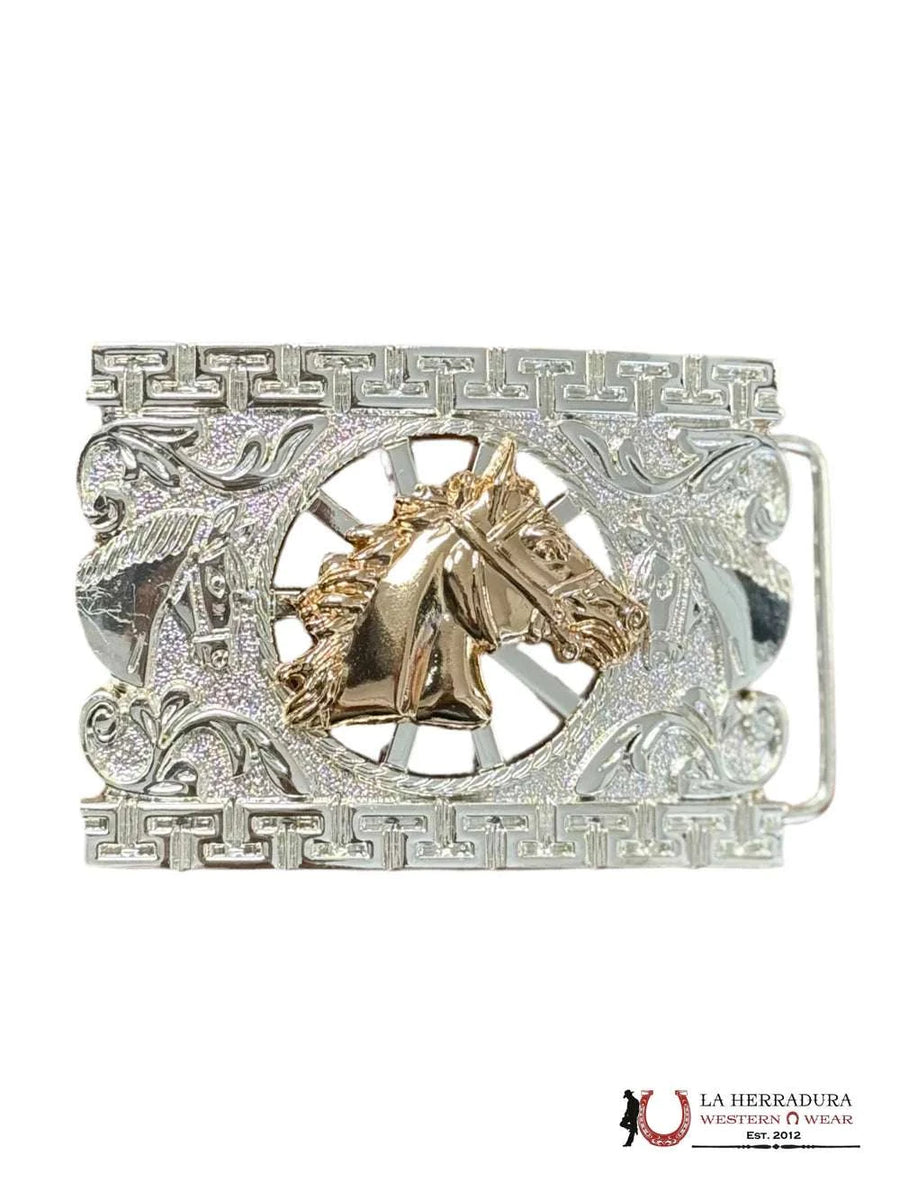
Trophy buckle. The oversized rodeo style, often three to four inches, with engraving, gold overlay or stone work. Meant to be seen.
Ranger set. A three or four piece set with buckle, one or two keepers and a tip, worn on a tapered strap. The dressiest western option.
Silver and hand engraved. Sterling or German silver with hand engraving, the kind of piece that holds value and pairs with tooled or exotic straps. Our Montana Silversmiths buckles cover this category, from classic engraved designs to rhinestone styles.
Will any buckle fit my belt?
Almost, with two conditions. The buckle bar has to match your strap width, and the strap has to be a snap style rather than a stitched one. A 1.5 inch buckle on a 1.5 inch strap always works. A trophy buckle that measures four inches across the face can still sit on a 1.5 inch strap, because the face size and the bar size are different measurements. If your strap is sewn closed around the buckle, the buckle is fixed.
Matching buckle metal. Keep your hardware in one family. Silver buckles go with a silver toquilla de plata, silver Montana jewelry and cooler leather tones like black, grey and antique. Gold and brass buckles suit cognac, tan, honey and chocolate leathers. Mixed metal buckles with gold overlay on a silver base are the safe pick when your boots and hat band do not agree.
Leather and materials explained
Leather grade matters more than price tag. Terms like genuine leather sound reassuring and actually describe a lower grade than full grain. Here is what you are really buying.
| Material | What it is | Wears like |
|---|---|---|
| Full grain cowhide | The complete outer hide with its natural grain intact | The longest lasting option. Darkens and develops a patina with age. |
| Top grain | Outer hide sanded and finished for uniform color | Very durable, more consistent looking, less character over time. |
| Tooled leather | Vegetable tanned cowhide hand carved with floral, Aztec or basketweave patterns | Stiff at first, softens beautifully. The classic dress western look. |
| Hair on cowhide (pelo de vaca) | Hide with the natural hair left on, in brindle, pinto or black and white | Bold and one of a kind, since no two hides match. Keep it away from water. |
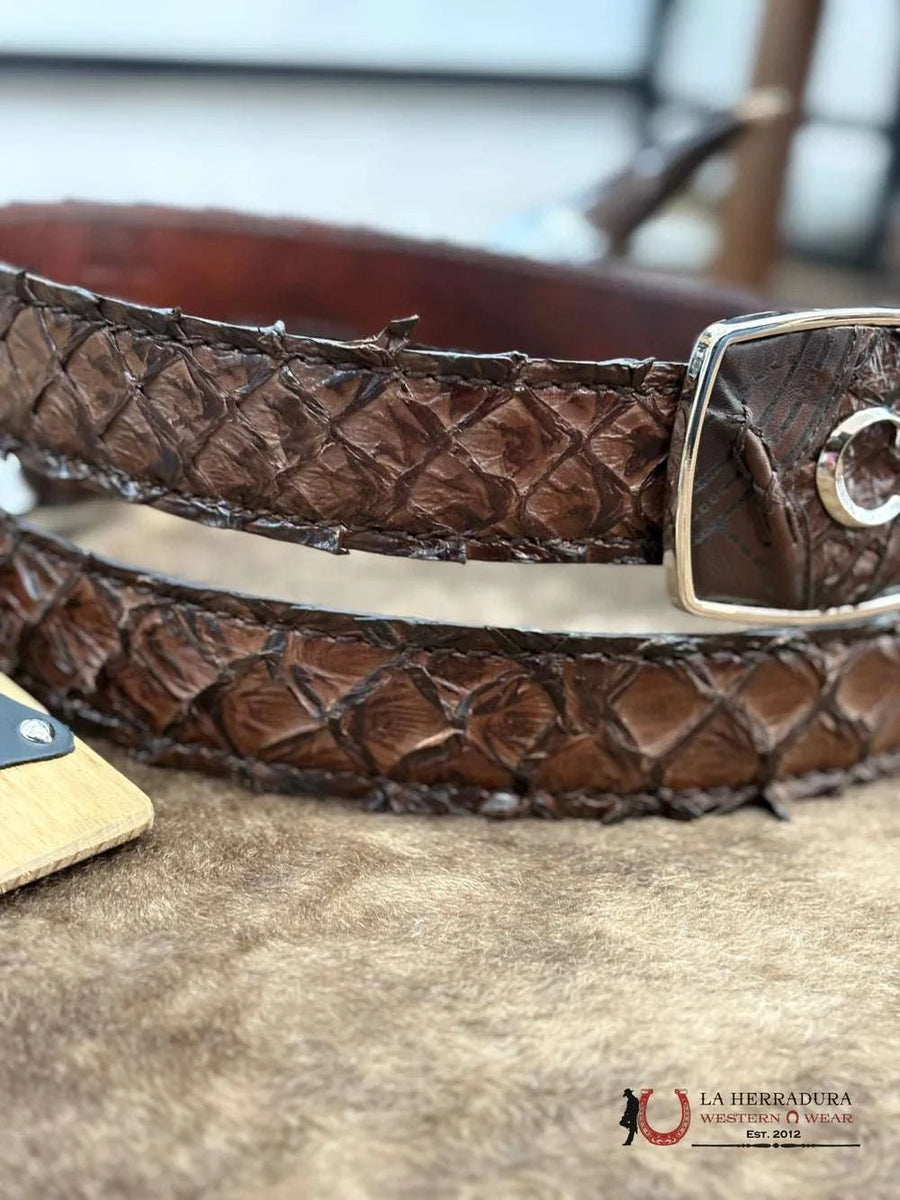
| Caiman and crocodile | Belly cut gives soft square tiles, hornback gives raised ridges | Very strong, formal, and the most recognizable exotic. |
| Ostrich | Quill marks are the follicles left when feathers are removed | Naturally oily, supple, resists cracking. Ages exceptionally well. |
| Python | Large flat scale pattern with high contrast | Light and eye catching. The scales need gentle handling. |
| Arapaima and fish | Large overlapping scales from freshwater and saltwater species | Distinctive texture, surprisingly tough, a favorite in ranchera styling. |
If you want one belt to cover most of your week, start with full grain cowhide in black or brown from leather belts. If you already have that covered, the premium belts range is where caiman, ostrich, python, fish and arapaima straps live, including Cuadra pieces built to match their boots.
Matching your belt to your boots
The old advice was that belt and boots must match exactly. In western wear the rule is looser and more useful. Aim for the same tone family rather than an identical shade. Chocolate boots take a cognac or chocolate belt. Black boots take black or a very dark brown. Bone, sand and beige boots open the door to almost any brown.
Texture is the part people miss. If your boots are a loud exotic, keep the belt calmer, and the other way around. A caiman boot with a caiman belt and a caiman wallet reads as a costume. One exotic piece per outfit lets it do its job.
Practical pairings from our own shelves:
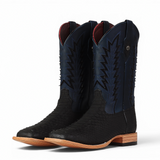
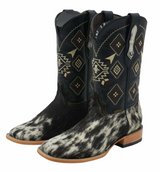
- Cowhide boots and men's cowhide styles with a busy hair on pattern go best with a plain smooth leather belt. Most cowhide boots are sold with the belt separate for exactly this reason.
- Caiman boots and ostrich boots match well with a tooled or plain strap in the same tone, letting the boot lead.
- Python boots and fish boots look sharpest with a solid dark belt and a silver buckle.
- Browsing the whole exotic leather collection first makes it easier to pick a belt that complements rather than competes.
Choosing by occasion
Everyday and work. Thick full grain cowhide, 1.5 inches, plain or lightly stitched, with a modest buckle. Nothing to snag, nothing to scratch, and it takes abuse without looking worse for it.
Rodeo, dances and nights out. This is trophy buckle territory. Pair a large silver or gold overlay buckle from the Montana silver range with a tooled or exotic strap, and let it sit as the center of the outfit.
Dress and formal western. A ranger set on a 1.25 inch tapered strap, in black or dark brown, with a matching tip and keepers. Understated, sharp, and correct with a blazer or a saco.
Gifting. A strap plus a separate buckle is the safest gift in western wear, because a size 36 strap fits a wide range and the buckle can always be swapped. Round it out with a men's wallet, a Cuadra premium wallet in matching leather, or a piece from western accessories.
Kids belts and buckles
Children's western belts follow the same add two inches rule against their pant size. Look for a narrower 1 to 1.25 inch strap so it passes through smaller jean loops, and a lighter buckle so it does not pull the waistband down. Many kids belts come with extra holes punched to stretch a growth season or two. Shop kids belts and kids buckles.
Caring for a western belt
- Rotate it. Wearing the same belt daily wears the same holes and creases. Two belts in rotation last more than twice as long as one.
- Condition two to four times a year. A small amount of quality leather conditioner on a soft cloth, worked in and buffed off. Skip conditioner on hair on hide and use a soft brush instead.
- Dry it slowly. If a belt gets soaked, lay it flat at room temperature. Heaters and direct sun make leather shrink and crack.
- Store it hanging or loosely rolled. Folding a belt creates a permanent crease across the strap.
- Exotics need a lighter hand. Wipe caiman, python and ostrich with a barely damp cloth and use a conditioner made for exotic skins. Never scrub against the scale direction.
- Watch the snaps. Check the buckle snaps a few times a year and press them fully closed. A loose snap is how belts get lost.
- The same cleaners and conditioners we use on boots work on belts. See our boot and hat care products.
Try it on before you commit
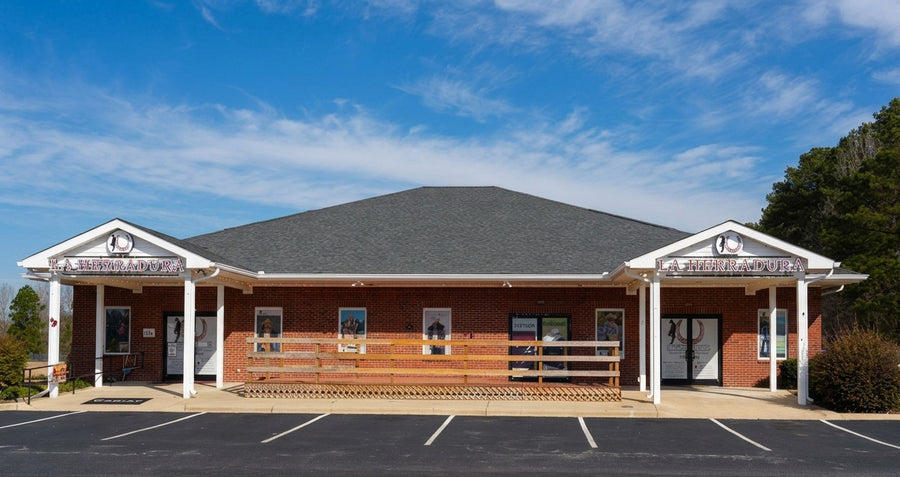
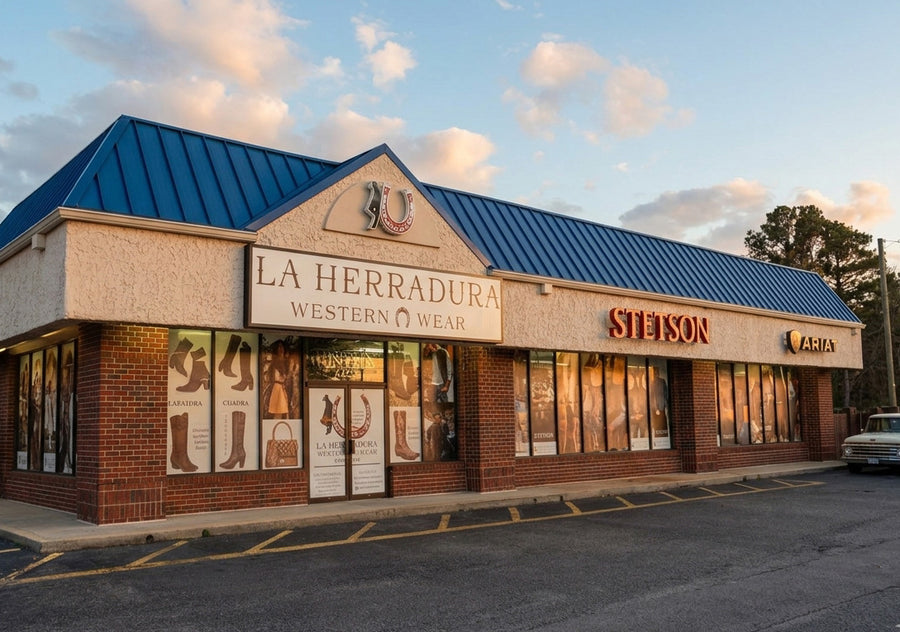
Our team fits belts, matches buckles to your boots and hat, punches holes, and shapes hats in store. Visit us in Selma, North Carolina or Columbia, South Carolina, see all store locations, or read about our in store hat and boot services. Online orders ship free over $200.
Frequently asked questions
What size western belt should I buy?
Add two inches to your pant waist size. A 34 inch waist takes a size 36 belt. Belt size is measured from the buckle fold to the center hole, which leaves two holes of adjustment on either side. See the full range of men's belts and women's belts.
What is the standard western belt width?
1.5 inches, or 38 mm. That width fits nearly every western buckle and trophy buckle on the market. Dress and ranger styles often use 1.25 inches, and some statement straps run 2 inches.
Can I change the buckle on my belt?
Yes, if your belt uses snaps at the buckle end. Unsnap the strap, slide the old buckle off the bar and fit the new one, then snap it closed. The buckle bar has to match the strap width. Browse buckles to see what will fit.
Do my belt and boots have to match exactly?
No. Staying in the same tone family is enough. Chocolate boots pair with chocolate or cognac belts, black with black or very dark brown. Keep only one loud exotic texture in the outfit at a time.
Which leather lasts the longest?
Full grain cowhide, because the natural grain is left intact and the fibers stay dense. Ostrich is the most durable exotic thanks to its natural oils. Genuine leather and bonded leather are lower grades and wear out much faster.
How do I shorten a belt that is too long?
Remove the buckle, trim the excess from the buckle end with a straight cut, then re-punch the snap holes and reattach. Bring it to one of our stores and we will do it for you rather than risk an uneven cut.
What is a trophy buckle?
An oversized decorative buckle in the rodeo award tradition, usually three to four inches across, often engraved and finished with gold or silver overlay. Despite the size, most trophy buckles fit a standard 1.5 inch strap. See the Montana Silversmiths range.
How do I clean a hair on cowhide belt?
Brush it gently in the direction of the hair with a soft brush and spot clean with a barely damp cloth. Do not soak it and do not apply liquid conditioner to the hair side, since both will mat the hide permanently.
Still have a question?
Check our FAQ page or contact us.
